Global Watch | The Irony Of Sanctions: As The West Funds Russia, India Safeguards Global Economic Order
US President Donald Trump has recently imposed an additional 25 per cent in tariffs on Indian exports to the United States for importing Russian crude, taking the total tariffs to a whopping 50 per cent. The argument is that India is “enabling" Russia to carry on its war against Ukraine by buying Russian oil.
Recommended Stories
Russian Oil Discounts Widen To $4 For India Amid Donald Trump's Tariff Offensive: Report

Trump says ready to impose ‘second phase’ of sanctions against Russia

President Trump Says US Has Carried Out Strike Against Drug-carrying Vessel from Venezuela

'Get Along Very Well With Modi; He's Great': Trump Praises PM But Deplores India-Russia Oil Trade

However, beneath the clamour of political rhetoric and dramatic posturing lies the irony: India’s procurement of Russian crude is not only rational but also necessary for even those who are decrying it. On the other hand, it is the West that is funding Russia by buying its oil in much larger quantities.
A deeper, objective look into the context would help dispel several myths that have been propagated against India. As Western countries severely sanctioned Russia after its invasion of Ukraine in early 2022, the European Union, which had been Moscow’s largest customer of oil and petroleum products (importing around 2.2 million barrels per day (bpd) of crude and 1.2 million bpd of refined oil products in 2021), faced a serious challenge.
The truth is that even as Western countries sharpened their tirade against trading with Russia and banned direct Russian imports, many of them kept acquiring Russian oil and gas through indirect routes. One of the key trade routes was to get it re-exported from Turkey. According to the Centre for Research on Energy and Clean Air (CREA), EU member states spent €21.9 billion (£18.1 billion) on Russian fossil fuels in the third year of the war, much more than their expenditure on financial aid to Ukraine. In fact, since the beginning of the war, EU countries have bought more energy fuel from Russia than India, with the former accounting for 23 per cent of Moscow’s earnings from fossil fuel exports, in contrast with India’s contribution of 13 per cent.
Now, while it is true that India’s crude import from Russia has surged since the war, from nearly negligible to now accounting for around 40 per cent of India’s total oil purchases, it is still not the largest consumer of Russian crude. China stands as the single largest buyer of Russian crude, primarily owing to the connectivity through pipelines, purchasing around 2 to 2.5 million bpd of oil. Moreover, the amendment of the G7 sanctions policy in September 2022, which put the price cap for Russian oil at $60 per barrel, incentivised India to not only take advantage of the huge discount for its humongous population but also diversify its crude acquisitions from costlier West Asian sources.
India is the world’s third-largest oil consumer, with a demand of around 5.2 million bpd. Therefore, to meet its domestic demand at affordable prices, the Indian government decided to shift its energy dependence away from West Asian and African nations by procuring discounted Russian crude. This, in turn, allowed these countries and the US to redirect their shipments and fulfil the energy vacuum created by the post-war sanctions for European countries. Thus, if India does not enable the continued circulation of Russian oil, the resultant destabilisation of the market can cause a wild surge in oil prices. According to analysts, the price could shoot up between $100 and $200 a barrel. Naturally, this will significantly hurt US and EU consumers as well, which is why the Biden administration had welcomed India’s purchases of discounted Russian crude, as it kept global oil prices from spiralling while also ensuring reduced revenues to Moscow.
In light of these facts, the blatant targeting of India by the Trump administration for its energy trade with Russia is absolutely bizarre. In addition to exaggerations regarding India’s gain from Russian oil imports, the country is being singled out and egregiously mischaracterised as “fuelling Russia’s war machine" even as China remains the largest buyer of Russian crude. China, as well as other countries that heavily import Russian oil—Saudi Arabia, Turkey, et al.—are not being slapped with similar punitive measures because of the US’s own geopolitical and economic assessment, which arguably is questionable, especially under the Trump administration.
It must be remembered here that many EU member states continue to indirectly source Russian fuels. Furthermore, Trump’s belligerent methods reveal themselves to be particularly problematic when one considers that India’s purchase of Russian oil is not only carrying out its own domestic interest but also acting as a shock absorber, effectively preventing a global oil price spiral and its cascading effects on food security and economic growth of a large number of countries.
There is another dimension that needs to be highlighted here. In choosing to buy crude from Russia or staying diplomatically neutral on the question of the Russia-Ukraine war in multilateral forums, India is exercising its policy of strategic autonomy. This principle is deeply embedded in Indian foreign policy, taking root from the non-alignment during the Cold War era. Russia has long been a close military and economic ally of India. Although current geopolitical pressures cannot be overlooked, India cannot jeopardise this decades-old, reliable relationship. So, when Trump targets and pressurises India to cut ties with Moscow, he is not just putting at risk the energy security for India as well as the world, but also challenging a sovereign nation’s right to carve its own foreign policy.
It is important to note that the US has already tightened the oil ecosystem through severe sanctions against Iran and Venezuela. It is also important to note that, unlike some other countries, India does not have a shadow banking system to bypass sanctions and thus functions transparently within global policy frameworks. Therefore, to unnecessarily poke a responsible and rational global actor like India when it demonstrably is safeguarding its own as well as global energy security interests is not just counterproductive but also reveals the short-sightedness and hypocrisy of Western energy politics. Whatever Western powers say due to their narrow, rash, and short-sighted geopolitical considerations, India is actually not the problem but a solution safeguarding the global economic architecture.
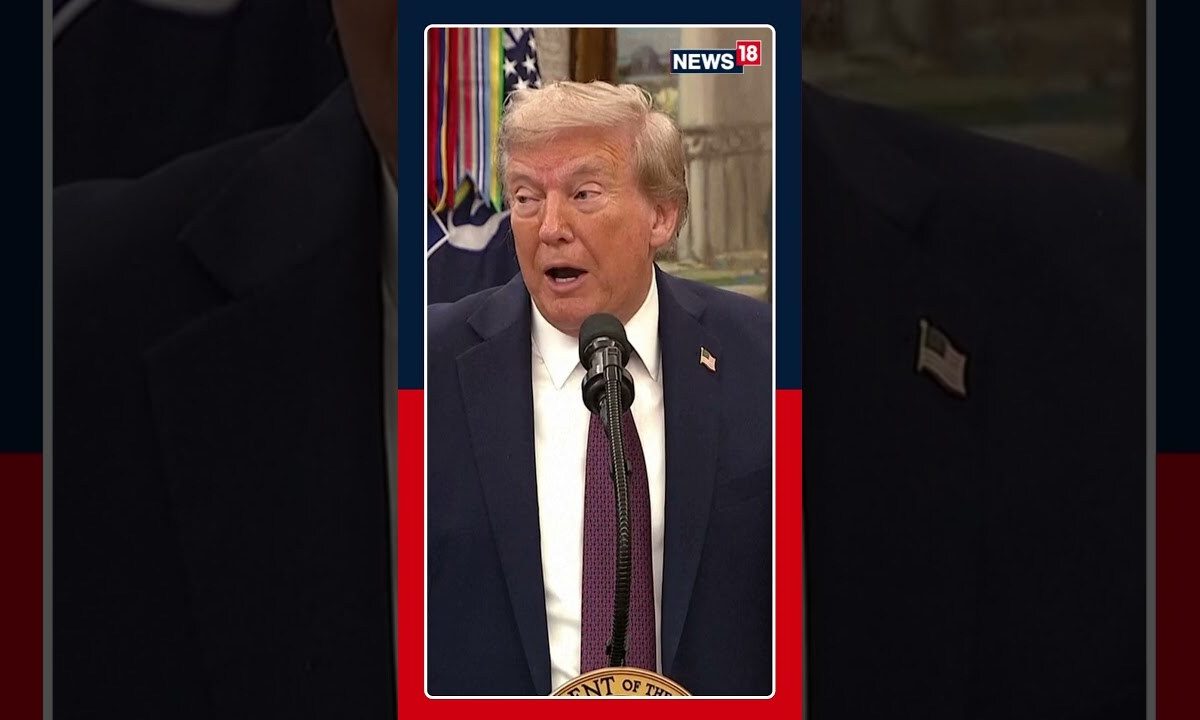
President Trump Says US Has Carried Out Strike Against Drug-carrying Vessel from Venezuela
The writer is an author and columnist. His X handle is @ArunAnandLive. Views expressed are personal and do not necessarily reflect News18’s editorial stance.

Comments