Family murder suicides in Yemen highlight depths of war-induced mental health crisis
Get link
Facebook
X
Pinterest
Email
Other Apps
By
terrorism watch
-
After more than four years of fighting, many of the dreams and livelihoods of those trapped in Yemen’s capital Sana’a have been dashed and hopes that the bloodletting will end anytime soon, have been laid to waste. “We’re
all depressed, everyone is poor, everyone has lost their jobs,” Nasser,
a 58-year-old, Sana’a-based father and former logistics coordinator
from a medical company abroad which has had to stop working in Yemen,
told Fox News. “Life was going well until the war came, now everything
is suspended. The worst thing, is people have now lost their hope.”
But beyond the physical decimation civilians are enduring – upwards of 100,000 people have been killed and 80 percent
of the 29 million population are in need of humanitarian assistance
nationwide – the psychological toll of the conflict is ravaging entire
families. According to Nasser, their community was devastated by
news last month that a father killed his three daughters – aged 7, 10
and 14 – before turning his gun on himself. “People are really
traumatized psychologically. (We think) he became isolated, many fathers
think that they are responsible for this bad situation and not being
able to take care of their families,” he said. “People don’t want to
join the violence groups, but they are feeling there are no more
choices. People believe now that every side of the war doesn’t care;
nothing will change.”
This
isn’t the only horrific incident. Nasser also revealed that around a
year ago, a man killed himself in addition to his three very young sons.
Some suspect that it is that sense of hopelessness – married to a fear
that the only avenue for male youths is fighting – is having some
alarming consequences.
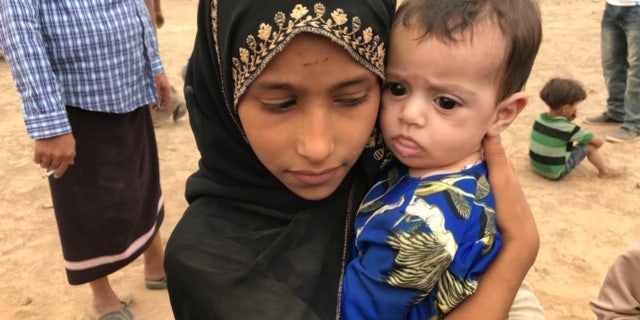
Children displaced from their homes in Sana'a amid the protracted conflict
(Fox News/Hollie McKay)
In 2017, a
40-year old woman in Yemen's Ibb province is said to have committed
suicide by swallowing a poisonous concoction – after first poisoning her
two daughters, aged 9 and 12 – according to The New Arab. The
war in Yemen was sparked in the months after the Iran-backed Houthis
took over the capital Sana’a and other pockets of the country in late
2014; prompting neighboring Saudi Arabia and allied countries to form a
coalition in an attempt to dislodge the opposition militia. But such a
goal has not been met as the conflict drags on. Despite being
deemed the poorest country in the Middle East even before war broke out,
young Yemenis sought to enroll in universities or start businesses, the
notion of taking up arms back then was something of a far-flung
profession.
People inspect the site of an airstrike by Saudi-led coalition
forces, in Sanaa, Yemen, Thursday, May, 16, 2019. Yemen's human rights
minister says heavy fighting is underway in the country's south as rebel
Houthis push to gain more territory from government forces and their
allies. The clashes come as the Saudi-led coalition carried out
airstrikes on the capital, Sanaa, earlier on Thursday, targeting the
Houthis and killing at least three civilians. (AP Photo/Hani Mohammed)
Nasser also bemoaned that the once tight trust that existed between neighbors and friends and family members has all but eroded. “We’ve
lost the connections between people, we have lost the trust,” he
continued. “People don’t want to leave their homes anymore.”
The
summer in Sana’a has also seen a rash of violence between tribal groups
aligned with the Houthis. And after the surprise announcement earlier
this month from the United Arab Emirates – a close ally in the Saudi-led
coalition – that it would be imminently drawing down
its ground troops from Yemen, the Saudi-led coalition also announced
over the weekend that it had launched a renewed operation to take out
air defense positions and ballistic missile depots in the Yemeni
capital. According to one Sana’a local, Hussain Albak, the
situation inside the city is “getting worse every day” with prices of
food and goods rising and more and more Yemenis have to sleep in the
soiled streets and can “only find an income through begging.” “I
have never seen so many Yemenis begging for money. Sana’a has become
really crowded,” Albak lamented. “There is no tap water, no government
electricity. We have to buy from a private company and the prices are so
high.”
Homeless fill the streets of the Houthi-controlled capital, Sana'a in Yemen
(Provided to FoxNews.com)
He noted that
while some schools are open, they aren’t like what they used to be given
that teacher’s salaries have not been paid in months. “Hospitals
are open, but there is nothing in them. The blockade is preventing
medicines from reaching us,” Albak continued, referencing the sea, land
and air campaign ignited by the coalition. “And when it does, it is so
expensive that it is impossible for poor people to get them at a public
hospital.”
Nasser, who has two sons aged five and eight, can only
afford to send his oldest to school and even that is poor quality and
mostly centered on “religious lessons and indoctrination.” Earlier
this month, a Houthi-operated Specialized Criminal Court (SCC)
sentenced 30 political opposition victims – known academics and
political figures – to death, in what Amnesty International characterizes as a “flawed legal process” and “trumped-up charges.”
A young boy seeking help in the government-controlled Ma'rib having escaped Sana'a
(Fox News/Hollie McKay)
Amnesty accused
the SCC of unlawfully rounding up “persons they deem to be opponents or
even just critics,” and has “documented the increased use of the SCC in
targeting religious minorities.” “Houthi forces have arbitrarily
arrested and detained critics and opponents as well as journalists,
human rights defenders and members of the Baha’i community, subjecting
scores to unfair trials, incommunicado detention and enforced
disappearance,” Amnesty stated, also accusing the
internationally-recognized Yemeni government has threatened and
arbitrarily detained activists.
With
hostilities raging, crucial land routes in recent months have been
shuttered – making it extremely dangerous and difficult for aid groups
to access vulnerable civilians in the region, according to UNICEF relief
reports. Moreover, the United Nations was forced to make it clear in
June that it would not allow the Houthis to divert humanitarian aid to
their supporters; rather than those civilians who are most in need, thus
halting much of the assistance program to Sana’a. “Yemen’s health
care infrastructure, particularly in front line areas, has been
decimated by shortages, attacks on hospitals,” said Defense Priorities
Director Benjamin H. Friedman. “The biggest concerns are disease, infant
mortality, malnourishment, and poverty.” In his view, both
parties to the conflict are to blame for the ongoing mayhem although the
coalition is behind many more deaths and destruction. “I do not
foresee any changes in government for Sana’a soon. It does not appear
that the Houthis are close to losing control of it,” Friedman asserted.
“What is more likely is a stabilization of their rule, and perhaps a
power-sharing deal with Yemeni rivals.”
In this Jan. 3, 2017 file photo, tribesmen loyal to Houthi rebels
chant slogans during a gathering aimed at mobilizing more fighters into
battlefronts to fight pro-government forces, in Sanaa, Yemen. (AP
Photo/Hani Mohammed, File)
One former White House National Security Council
official, who spoke on the condition of anonymity, told Fox News that
initially there was some public tolerance for the Houthis among the
population because they were seen as “fighting back against foreign
aggressors,” but poor governance has led to a widespread dissatisfaction
with “how poorly the Houthis are governing in Sana’a.” “Government
offices now have Houthi representatives making decisions that they just
don’t have the expertise or knowledge to make competently. Houthi
mismanagement and poor governance are making the already outrageous
humanitarian situation worse,” the source said. “But mostly, Yemenis
living under Houthi rule don’t rise up against it because they are
unclear of the alternative.”
Indeed, many look to security-wracked other parts of the nation and draw conclusions it could always be worse. For
one, Albak surmised that the prices of most basic things have tripled
throughout the course of the protracted conflict, and despite the steep
challenges of life amid war, acknowledged that “Houthi control was good
so far” and a better alternative to being controlled by a terrorist
outfit such as Al Qaeda in the Arabian Peninsula (AQAP) which operates
in the south of Yemen. “I don’t know how we are all surviving. But
we are,” Nasser added. “We hope there will be a peace agreement and an
end to this, but the leaders need to remember that can be no peace
without justice.”
In fact, no ideology has been as genocidal as Islam… Islam has killed more than 5 times the number of people killed by communism. In the total numbers we have updated over 80 million Christians killed by Muslims in 500 years in the Balkan states, Hungary, Ukraine, Russia. Then we have India. The official estimate number of Muslim slaughters of Hindus is 80 million. However, Muslim historian Firistha (b. 1570) wrote (in either Tarikh-i Firishta or the Gulshan-i Ibrahim) that Muslims slaughtered over 400 million Hindus up to the peak of Islamic rule of India, bringing the Hindu population down from 600 mil to 200 million at the time. With these new additions the Muslim genocide of non-Muslims since the birth of Mohammed would be over 669 million murders. Islam: The Religion of Genocide Perspective: Think the Spanish inquisition was bad? More people are killed by Islamists each year than in all 350 years of the Spanish Inquisition* combined. The Spanish inquisition ( Tri...
SINGAPORE (Reuters) -Chinese efforts to spy on the Dutch are intensifying, with the focus on semiconductors, Dutch Defence Minister Ruben Brekelmans said on Saturday. "The semiconductor industry, which we are technologically leading, or technology advanced, of course, to get that intellectual property - that's interesting to China," Brekelmans said in an interview on the sidelines of the Shangri-La Dialogue security meeting in Singapore. The Dutch military intelligence agency said in its annual report in April last year that Chinese spies have targeted the Dutch semiconductor, aerospace and maritime industries to try to strengthen China's armed forces When asked if the spying had stopped, Brekelmans said: "It's continuing. In our newest intelligence reports, our intelligence agency said that the biggest cyber threat is coming from China, and that we do see most cyber activity when it comes to us being as from China. That was the case last year, but that's...
Kabul: Five members of the US-led international military coalition were killed on Saturday by a roadside bomb in southern Afghanistan, the latest deadly attack against foreign troops since the Taliban announced the start of their spring offensive this week. The renewed violence came as Afghan President Hamid Karzai acknowledged that his government has been receiving funds from CIA for more than a decade as part of regular monthly assistance from the US government. Karzai told reporters at a news conference that the CIA's station chief in Kabul has assured him that regular funding the US intelligence agency gives his government will not be cut off. Karzai had earlier confirmed that his government had received such payments following a story published in The New York Times that said the CIA had given the Afghan National Security Council tens of millions of dollars in monthly payments delivered in suitcases, backpacks and plastic shopping bags. "The help and assistance f...
 Children displaced from their homes in Sana'a amid the protracted conflict
(Fox News/Hollie McKay)
In 2017, a
40-year old woman in Yemen's Ibb province is said to have committed
suicide by swallowing a poisonous concoction – after first poisoning her
two daughters, aged 9 and 12 – according to The New Arab.
Children displaced from their homes in Sana'a amid the protracted conflict
(Fox News/Hollie McKay)
In 2017, a
40-year old woman in Yemen's Ibb province is said to have committed
suicide by swallowing a poisonous concoction – after first poisoning her
two daughters, aged 9 and 12 – according to The New Arab.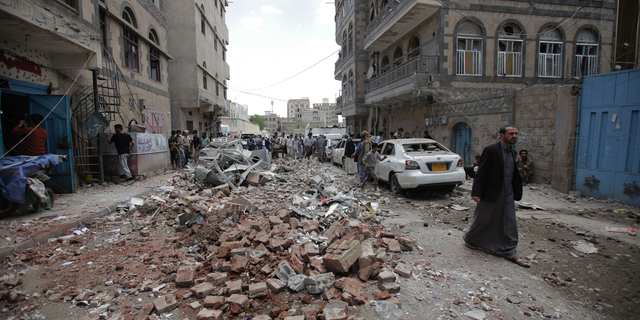 People inspect the site of an airstrike by Saudi-led coalition
forces, in Sanaa, Yemen, Thursday, May, 16, 2019. Yemen's human rights
minister says heavy fighting is underway in the country's south as rebel
Houthis push to gain more territory from government forces and their
allies. The clashes come as the Saudi-led coalition carried out
airstrikes on the capital, Sanaa, earlier on Thursday, targeting the
Houthis and killing at least three civilians. (AP Photo/Hani Mohammed)
Nasser also bemoaned that the once tight trust that existed between neighbors and friends and family members has all but eroded.
People inspect the site of an airstrike by Saudi-led coalition
forces, in Sanaa, Yemen, Thursday, May, 16, 2019. Yemen's human rights
minister says heavy fighting is underway in the country's south as rebel
Houthis push to gain more territory from government forces and their
allies. The clashes come as the Saudi-led coalition carried out
airstrikes on the capital, Sanaa, earlier on Thursday, targeting the
Houthis and killing at least three civilians. (AP Photo/Hani Mohammed)
Nasser also bemoaned that the once tight trust that existed between neighbors and friends and family members has all but eroded.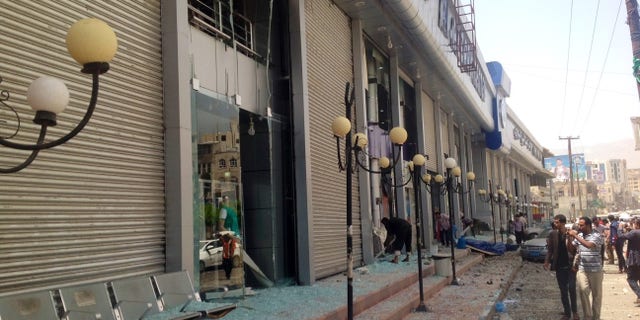 Homeless fill the streets of the Houthi-controlled capital, Sana'a in Yemen
(Provided to FoxNews.com)
He noted that
while some schools are open, they aren’t like what they used to be given
that teacher’s salaries have not been paid in months.
Homeless fill the streets of the Houthi-controlled capital, Sana'a in Yemen
(Provided to FoxNews.com)
He noted that
while some schools are open, they aren’t like what they used to be given
that teacher’s salaries have not been paid in months.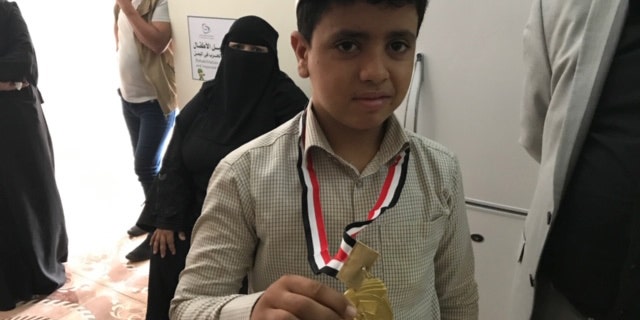 A young boy seeking help in the government-controlled Ma'rib having escaped Sana'a
(Fox News/Hollie McKay)
Amnesty accused
the SCC of unlawfully rounding up “persons they deem to be opponents or
even just critics,” and has “documented the increased use of the SCC in
targeting religious minorities.”
A young boy seeking help in the government-controlled Ma'rib having escaped Sana'a
(Fox News/Hollie McKay)
Amnesty accused
the SCC of unlawfully rounding up “persons they deem to be opponents or
even just critics,” and has “documented the increased use of the SCC in
targeting religious minorities.”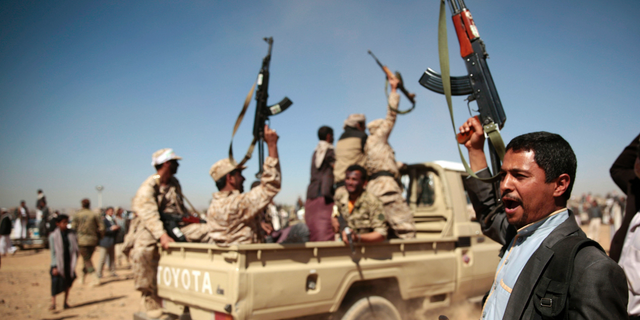 In this Jan. 3, 2017 file photo, tribesmen loyal to Houthi rebels
chant slogans during a gathering aimed at mobilizing more fighters into
battlefronts to fight pro-government forces, in Sanaa, Yemen. (AP
Photo/Hani Mohammed, File)
One former White House National Security Council
official, who spoke on the condition of anonymity, told Fox News that
initially there was some public tolerance for the Houthis among the
population because they were seen as “fighting back against foreign
aggressors,” but poor governance has led to a widespread dissatisfaction
with “how poorly the Houthis are governing in Sana’a.”
In this Jan. 3, 2017 file photo, tribesmen loyal to Houthi rebels
chant slogans during a gathering aimed at mobilizing more fighters into
battlefronts to fight pro-government forces, in Sanaa, Yemen. (AP
Photo/Hani Mohammed, File)
One former White House National Security Council
official, who spoke on the condition of anonymity, told Fox News that
initially there was some public tolerance for the Houthis among the
population because they were seen as “fighting back against foreign
aggressors,” but poor governance has led to a widespread dissatisfaction
with “how poorly the Houthis are governing in Sana’a.”
Comments